Categories
Artworks Featured Works

Govardhan Leela

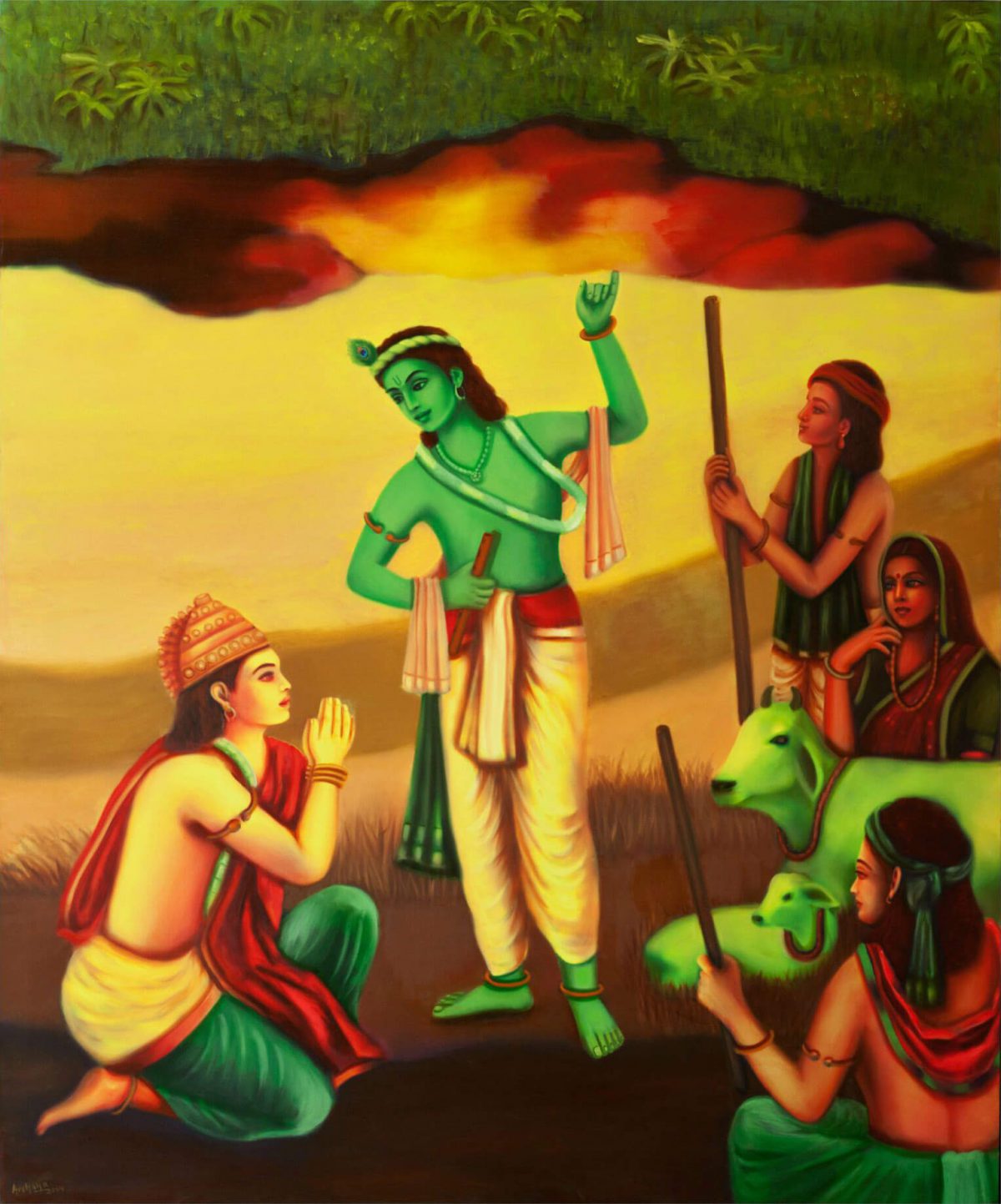
Thousands of years ago, Lord Krishna lifted Govardhan Hill on the little finger of His left hand and held it up for seven days to protect His kinsfolk and denizens of Vrindavan from the wrath of demigod Indra (the god of rain). In this way He subdued the arrogance of Indra who had become disdainfully proud of his strength and protected the inhabitants of Vrindavan.

As per the legend, Krishna saw huge preparations for the annual offering to Indra. He inquired His father, Nanda about the ritual. Nanda told Krishna that it was an age old tradition of serving demigods so that demigods could take care of them. At this, Krishna explained to the villagers of Vrindavan their true ‘dharma’ and advised them to concentrate only on farming and protecting their cattle. Krishna asked His father to forgo the sacrifice to Indira and worship the Govardhan hill which was responsible for the rain and the growth of grains. Nanda and the other cowherd men got convinced and performed the puja for Govardhan.

While performing puja for Govardhan, the inhabitants of Vrindavan saw Krishna in each Govardhan-shila (stone)

This angered Indra, who then unleashed torrential rains to flood the village. Krishna, in response, lifted Govardhan hill, under which all the animals and people of the region took shelter, safe from Indra’s fury. Indra finally accepted defeat, recognised Krishna as the Supreme Personality of Godhead and offered his prayers.

In order to stop appeasement-oriented sacrificial worship by His devotees, Krishna wanted to firmly establish exclusive devotional service during His presence in Vrindavana.

This pastime proves Krishna’s unlimited love for His devotees. In Bhagavad-gita Lord Krishna assures us that if we abandon all varieties of religion and just surrender to Him, He will protect us in all situations.

sarva-dharman parityajya mam ekam saranam vraja aham tvam sarva-papebhyo moksayisyami ma sucah

(Abandon all varieties of religion and just surrender unto Me. I shall deliver you from all sinful reaction. Do not fear.)(Bhagavad-gita 18.66)

Categories
Artworks Featured Works

Baal Leela

As per the legend, Lord Krishna as an infant was crawling on the ground and mother Yashoda suspected that He had eaten “mitti” (clay). A concerned Yashoda asked Him again and again to open His mouth. When Krishna finally opened His mouth, Yashoda could see therein the entire universe with its vast expanse, with complete opulence of creation, all living entities, all activities eternal time, material nature, spiritual nature, consciousness and different forms of the whole creation. Upon this divine sight, Mother Yashoda fainted.

Lord Krishna again expanded His internal energy just to bewilder her with maternal affection. Immediately mother Yashoda forgot all the philosophical speculations and accepted Krishna as her own child. So mother Yashoda considered, loved and treated Him just as her son instead of revering Him as God even after that incident.

Categories
Artworks Featured Works

Krishna- Protector and Provider

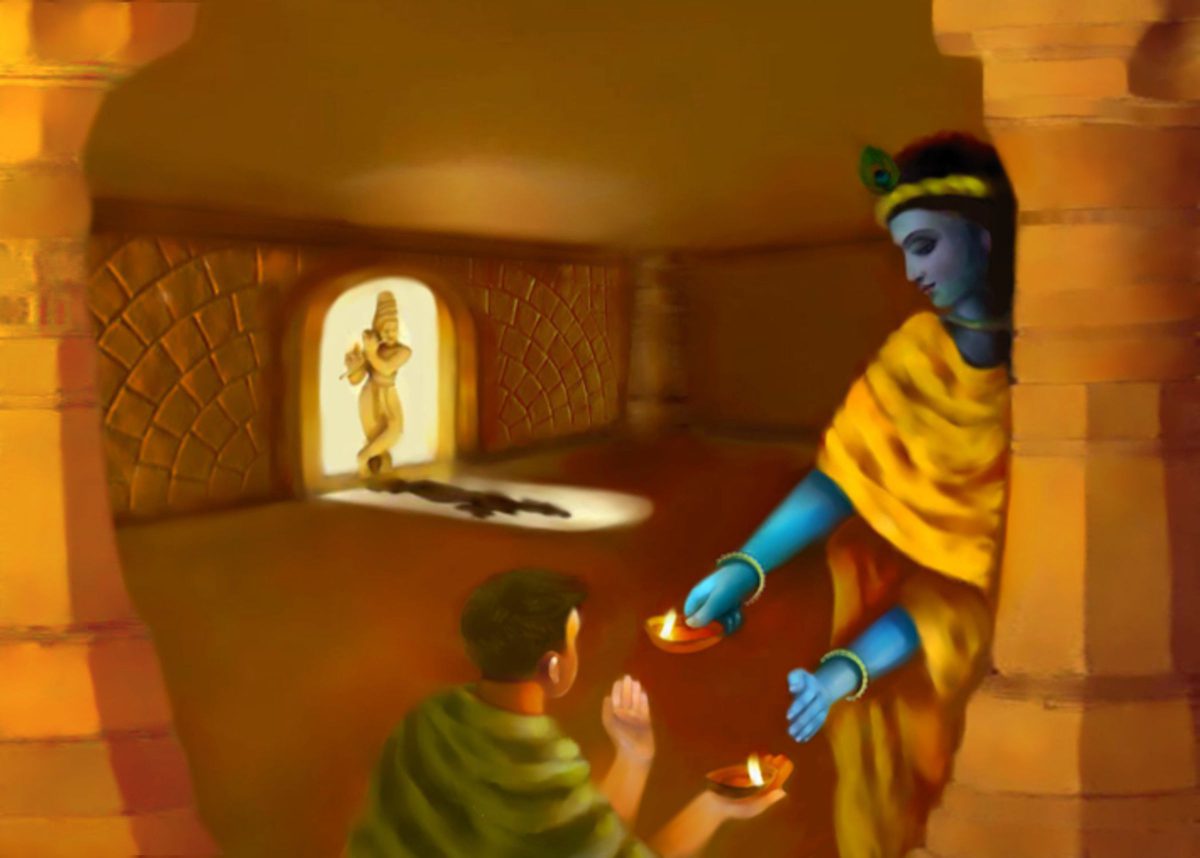
ananyas cintayanto mam ye janah paryupasate tesam nityabhiyuktanam yoga-ksemam vahamy aham (BG 9: 22) Lord Krishna says “Those who worship Me with devotion, meditating on My transcendental form-to them I carry what they lack and preserve what they have” When a devotee offers oneself exclusively to him, māmekaṁ śharaṇaṁ vraja (surrender fully unto Me), God bestows his complete grace and takes full responsibility, by preserving what he has and providing what he lacks.

Categories
Artworks Featured Works

Damodar Leela

Krishna, once annoyed mother Yashoda to the extent that she attempted to bind Him with a wooden mortar. Yashoda did not know that her child was the Supreme Personality of Godhead Who is unlimited and all-pervading. Although Lord Krishna Himself is the whole cosmic manifestation and beyond the reach of all senses, being compassionate towards His devout mother, He allowed Himself to be bound by her with ropes.

During the course of this leela (often referred to as ‘Damodar leela’) in Vaishnav literature, two demigods, who, under a curse of Narada, were standing as trees in the court-yard of Yashoda and Nanda, got liberated from their curse and assumed their original effulgent forms.

Categories
Artworks Featured Works

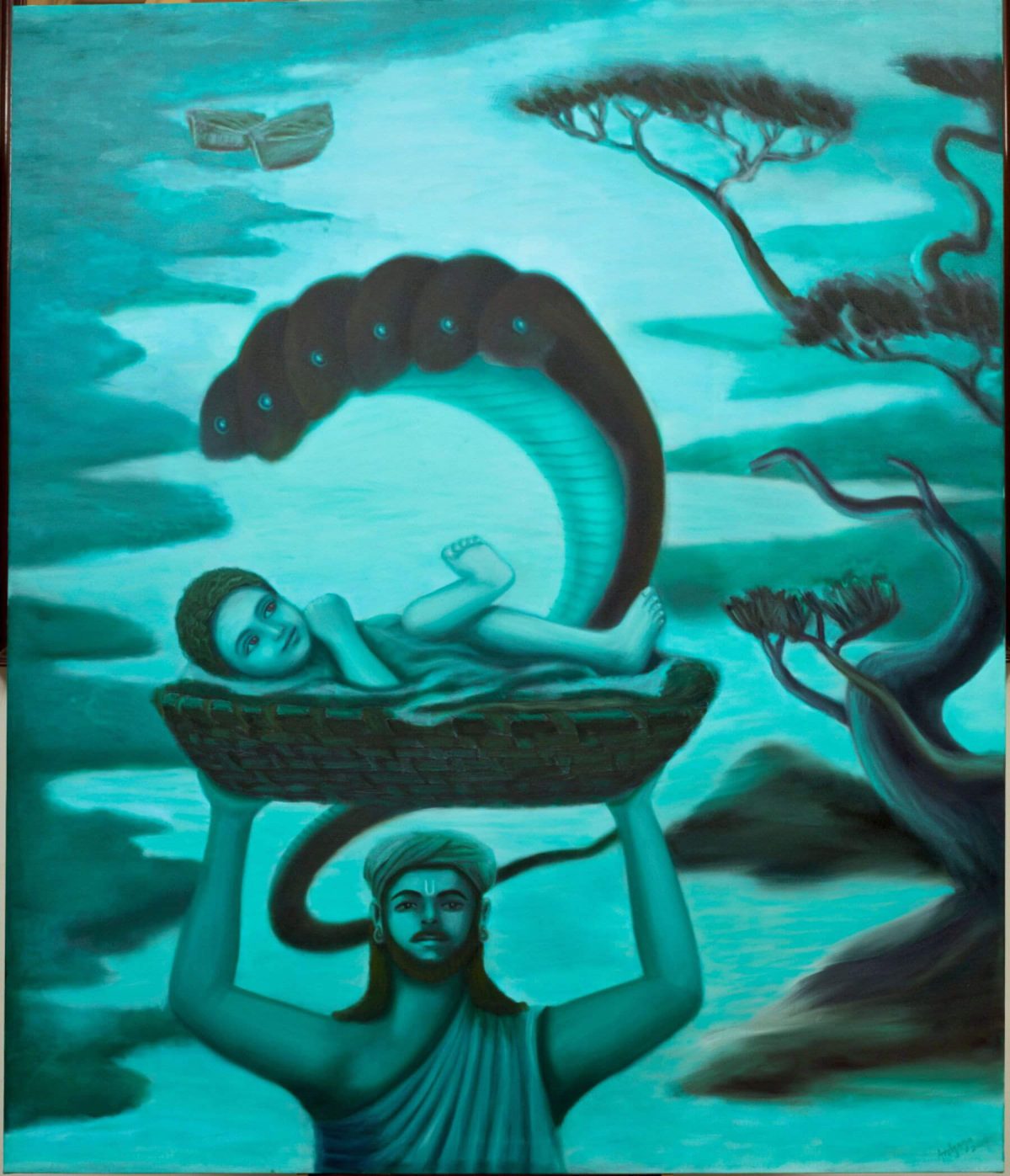
Krishna & Vasudev

yada yada hi dharmasya glanir bhavati bharata abhyutthanam adharmasya tadatmanam srjamy aham

Whenever and wherever there is a decline in religious practice, O descendant of Bharata, and a predominant rise of irreligion-at that time I descend Myself.(Bhagvad – Gita 4:7)

Afraid of a prophecy that predicted his death at the hands of the eighth son of Devaki, King Kamsa, the brother of Devaki, had incarcerated the couple in a prison cell. It was there at the stroke of midnight that Lord Krishna appeared before an expecting Devaki in His four-armed Vishnu form, carrying the conch, disc, club and lotus. Devaki and Vasudev, prayed to Him to turn Himself into their baby. The Lord advised Vasudeva to take Him to Gokul and then turned Himself into a new-born baby called Krishna.

Magically, with the appearance of Krishna, the guards in Kamsa’s prison fell asleep, and all the iron shackles, chains and locks automatically opened. Wasting no time, Vasudev picked up the baby, and carrying Him in a basket, started towards Gokul. It was a dark stormy night with blinding rain continuously pouring from the sky. When Vasudev reached the bank of river Yamuna, the river was in spate and stormy winds were blowing. Vasudev was in a fix and didn’t know what to do.

Suddenly a miracle happened – the river parted and Vasudev walked through the river. Throughout the journey, Vasudev and the baby were protected from rain by the hood of the great eternal snake, Vasuki. Finally, Vasudev reached Nanda’s house in Gokul safely. Krishna was brought up along with his brother, Balram by Yashoda & Nanda in Gokul. Vrindavan and Gokul provided the stage for numerous childhood leelas of the Lord.

The sole objective of Sri Krishna’s appearance on earth was to eradicate the evil and establish the true religion.

Categories
Artworks Featured Works

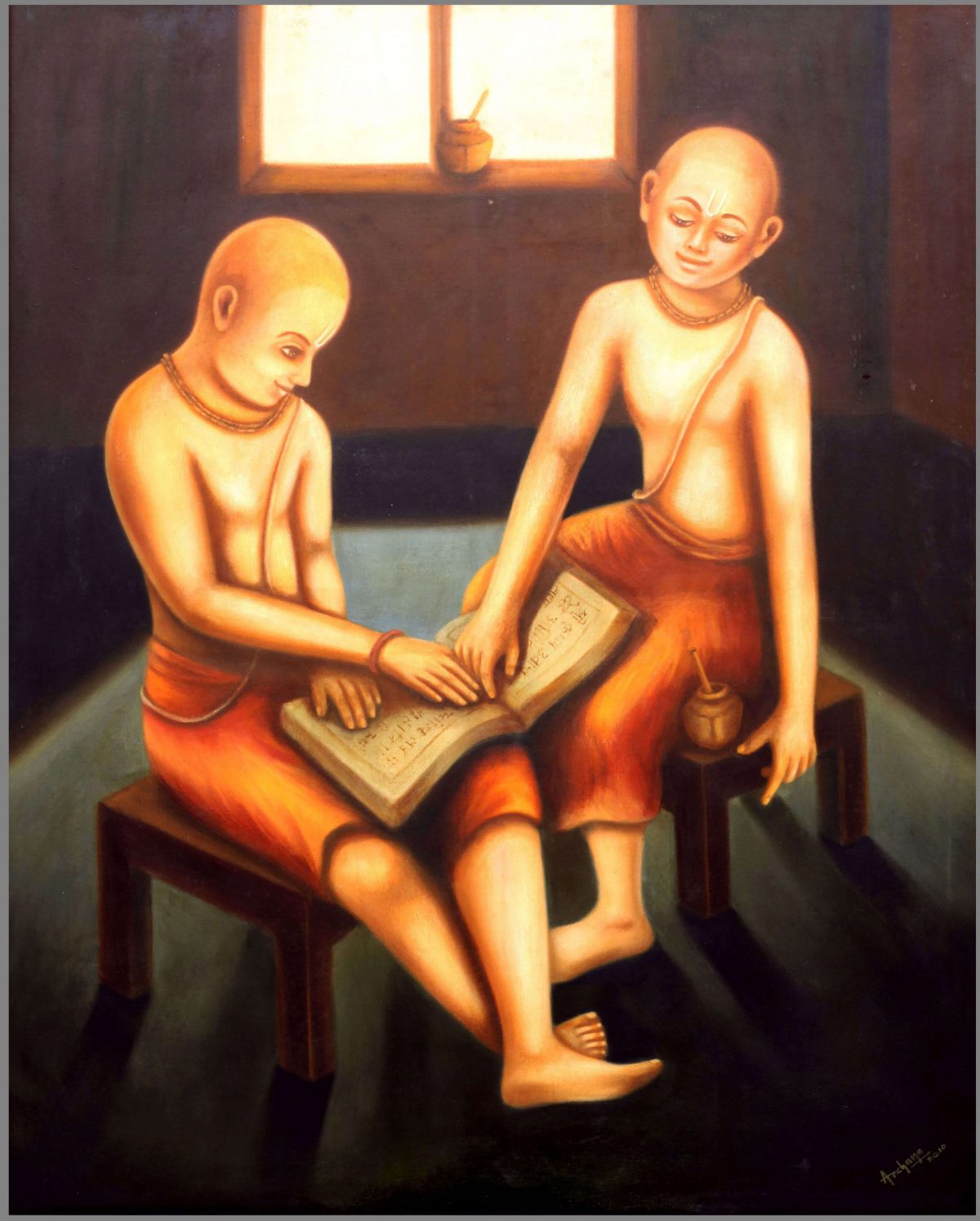
The Young Monks

Vaishnava Monk or Brahmachari is a person in monastic order whose attention is fixed on the Supreme being and he dedicates his life to the welfare of the people. Brahmacharya literally means Achara or conduct that leads to the realisation of Brahman (God). Saffron dhoti, shaved head with sikha, Tulasi neck-beads and tilaka markings are special features of a Vaishnava monk.

Categories
Artworks Featured Works

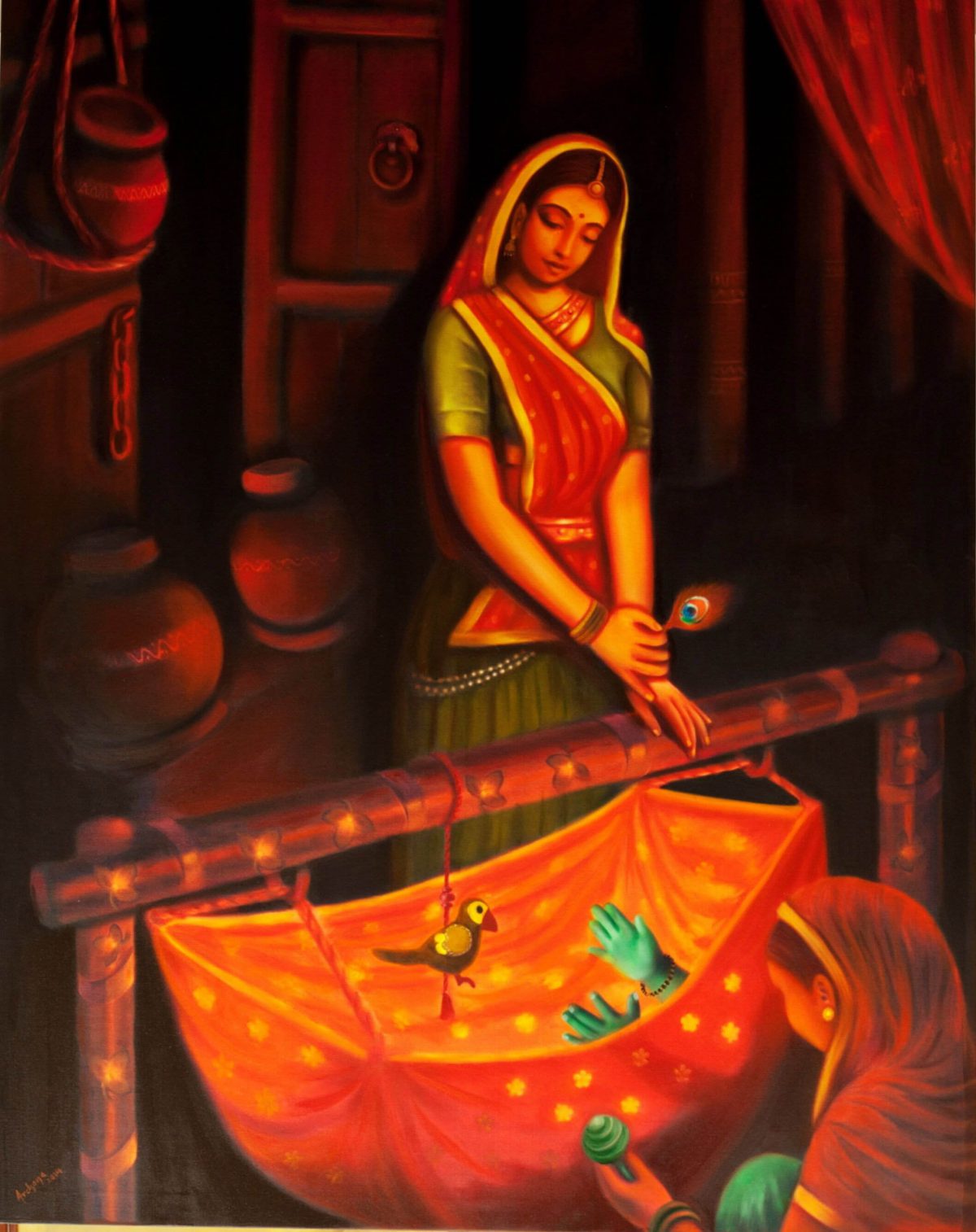
Krishna in Cradle

“Despite having scores of servants and attendants, Mother Yashoda would seize every opportunity to render personal service (seva) to her dear son, Krishna.” As per Puranic texts, Yashoda was the wife of Nanda and the foster-mother to Krishna. Lord Krishna was born to Devaki and was given to Yashoda and Nanda in Gokul by Krishna’s father Vasudeva on the night of His birth, for His protection from Devaki’s brother, the king of Mathura, Kamsa. Yashoda’s deep affection for Krishna is the highest manifestation of ‘Vatsalya Prema’ (parental love) and even ‘Vatsalya Bhakti’ (parental devotion).

Categories
Artworks Featured Works

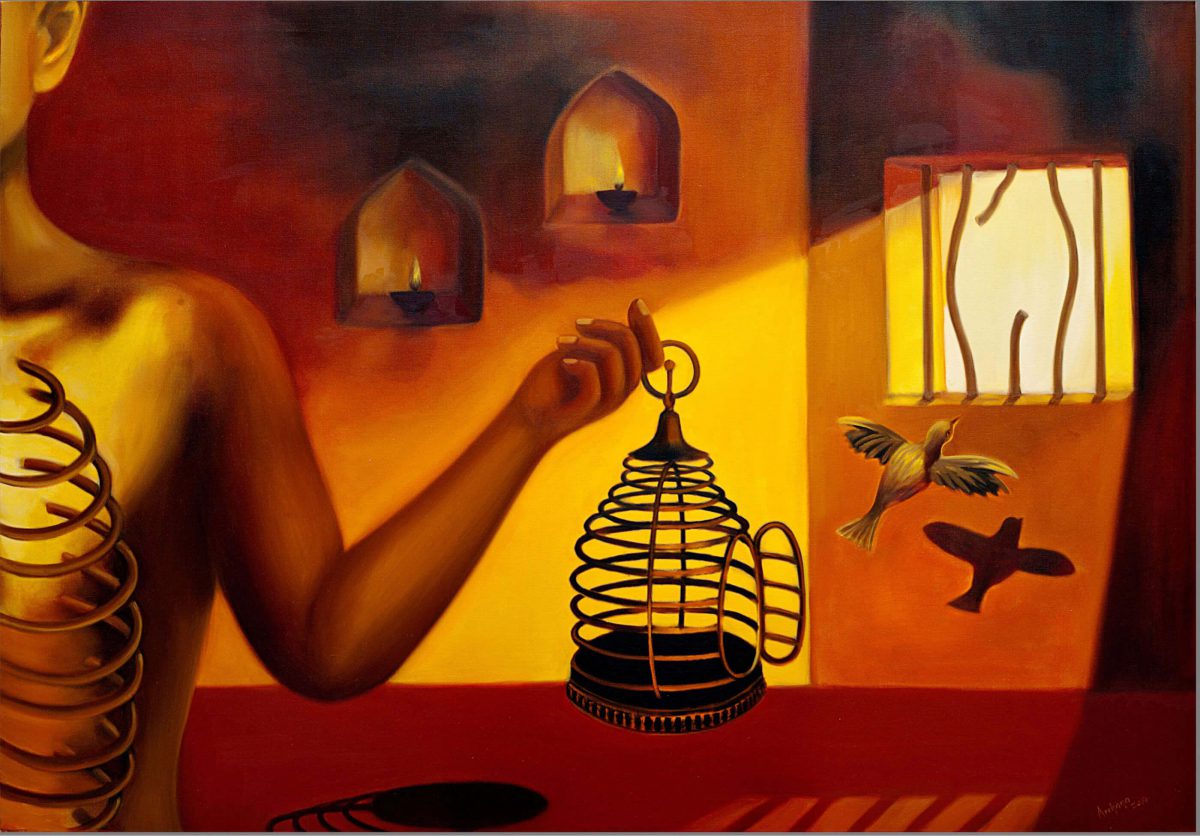
The Caged Bird

Material body of living being is often likened with a cage and soul of a living being is likened with a bird. Just as a bird is trapped in a cage likewise soul is trapped in the body.

Through this analogy it is conveyed that once the bird (soul) leaves the cage (body) (after death) and remains in the same room (material world), it would keep getting trapped in one cage or the other. The cage (body) or cage-type (specie) will change but the bird will remain trapped in a cage (material body). Puranik scriptures recommended that the living-entity should break open the window of the material world and enter the world-beyond which signifies eternal realm or spiritual world. After attaining that spiritual world one does not have to return in this material world and one is freed from repeated cycle of birth and death.

In Bhagavad-gita the bona-fide method of getting rid of repeated life and death is explained in detail.

janma karma ca me divyam evam yo vetti tattvatah tyaktva deham punar janma naiti mam eti so ‘rjuna (One who knows the transcendental nature of My appearance and activities does not, upon leaving the body, take his birth again in this material world, but attains My eternal abode, O Arjuna) (Bhagvad-gita 4.9)

Categories
Artworks Featured Works

The Life Cycle

This painting is portraying the following verse of Bhagavadgita dehino ‘smin yathā dehe kaumāraṁ yauvanaṁ jarā tathā dehāntara-prāptir dhīras tatra na muhyati (BG 2:13) (As the embodied soul continuously passes, in this body, from boyhood to youth to old age, the soul similarly passes into another body at death. A sober person is not bewildered by such a change)

Every material entity is suffering in the grind of Life and Time.

Any man who has perfect knowledge of the constitution of the individual soul, the Supersoul, and nature – both material and spiritual – is called a dhīra, or a most sober man. Such a man is never deluded by the change of bodies.

Categories
Artworks Featured Works

The Five Senses & The Soul

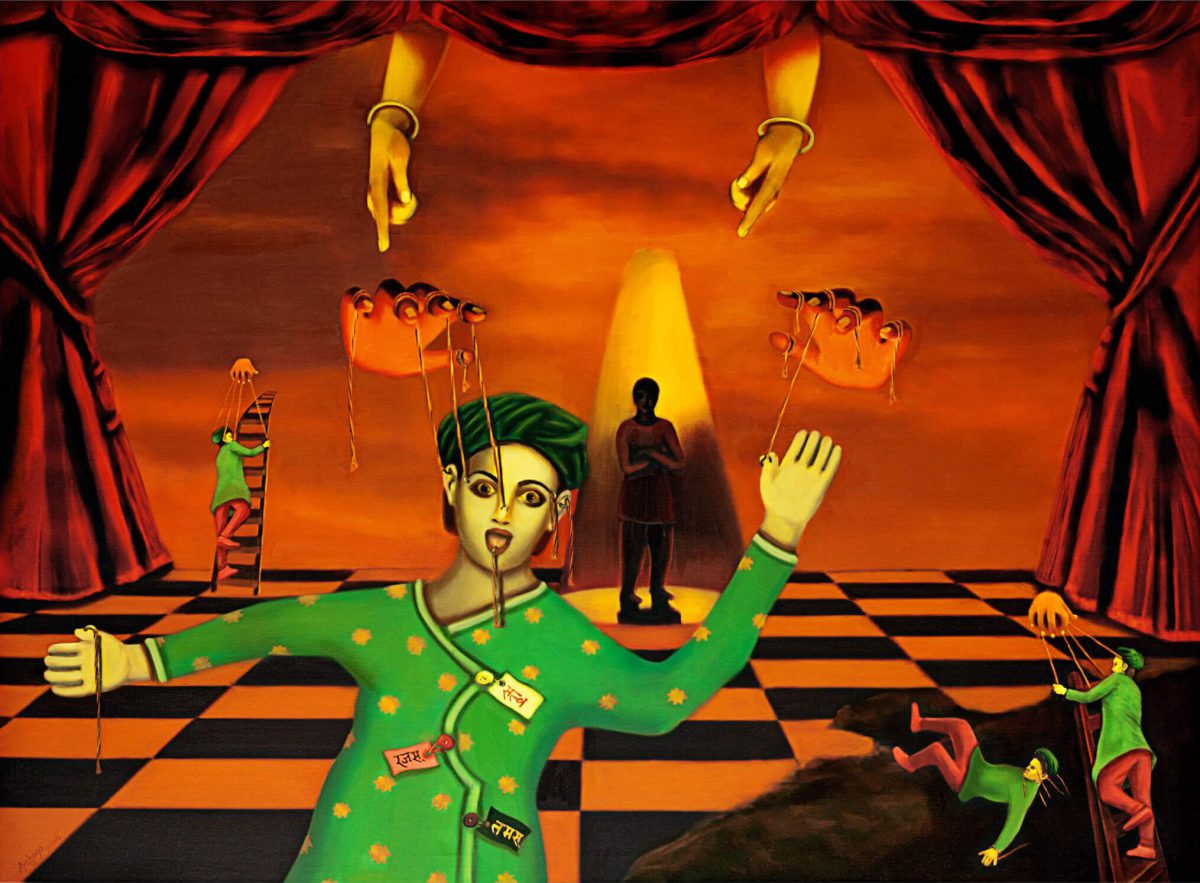
This painting portrays the following three verses of Bhagavad-gita

  1. “indriyani parany ahur indriyebhyah param manah manasas tu para buddhir yo buddheh paratas tu sah”
    (The working senses are superior to dull matter; mind is higher than the senses; intelligence is still higher than the mind; and he (the soul) is even higher than the intelligence.) (Bhagavad-gita 3.42)
    The Shloka implies that the senses should be controlled by mind, mind should be controlled by intelligence under the direction of soul.
  2. upadrastanumanta ca bharta bhokta mahesvarah paramatmeti capy ukto dehe ‘smin purusah parah
    (Yet in this body there is another, a transcendental enjoyer who is the Lord, the supreme proprietor, who exists as the overseer and permitter, and who is known as the Super-soul.) (Bhagavad-gita 13:23)
    This verse states that within the heart of a living being, the Supreme Personality of Godhead resides as the Super-soul. The Super-soul rests beside the individual soul and acts as a witness.
  3. ūrdhvaṁ gacchanti sattva-sthā madhye tiṣṭhanti rājasāḥ jaghanya-guṇa-vṛtti-sthā adho gacchanti tāmasāḥ
    (Those situated in the mode of goodness or sattva gradually go upward to the higher planets; those in the mode of passion or rajas live on the earthly planets; and those in the mode of ignorance or tamas go down to the hellish worlds.) (Bhagavad-gita 14:18)

In this painting through the analogy of puppet, five senses (eyes, ears, nose, tongue and skin) are portrayed. The cords attached to the senses represent mind. the pair of hands controlling the cords represents intelligence and the pair of hands at the top giving directions represents individual soul.